Two thighs, forty years apart: what one MRI tells us about strength training
A 74-year-old sedentary man and a 70-year-old triathlete. Same scanner, same slice, almost the same age — and a difference in muscle and fat so stark it became one of the most reproduced images in exercise medicine. Here is the story behind it, and what the research really says about using strength training to keep the body you have.
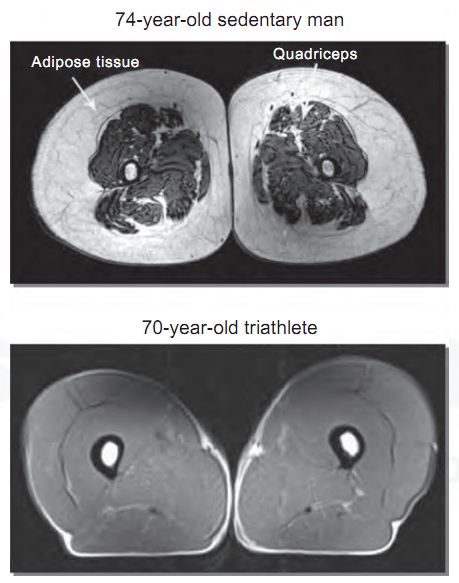
In 2011, a radiologist in Pittsburgh published an image that has since shown up in cardiology conferences, geriatric medicine textbooks, longevity podcasts, and the slide decks of half the strength coaches on the internet. It is not a graph. It is not a chart. It is two MRI cross-sections of the human thigh, stacked one above the other, taken at the same level of the femur.
The top scan is a 74-year-old man who has been sedentary for most of his adult life. The bottom scan is a 70-year-old triathlete who has trained consistently for decades. They are almost the same age. They are scanned on the same machine. And the difference is so visually unambiguous that it does not need a caption to land.
The sedentary thigh is mostly fat with muscle hidden inside it. The athlete's thigh is mostly muscle, with a thin rim of fat around the outside. The bone is in the same place. Four years of age explains none of this.
Where the image actually comes from
The scans are from Chronic exercise preserves lean muscle mass in masters athletes (Wroblewski, Amati, Smiley, Goodpaster & Wright, The Physician and Sportsmedicine, 2011). The team recruited 40 masters athletes aged 40 to 81 — runners, cyclists, swimmers, triathletes — who trained four to five times a week and had done so for decades. They measured mid-thigh muscle area, intramuscular fat, and quadriceps strength, then compared the results to age-matched sedentary controls drawn from the broader Pittsburgh aging cohort.
The finding that made the cover image famous: the athletes in their 70s and 80s had mid-thigh muscle area and quadriceps strength comparable to active people in their 40s. The expected age-related decline in lean mass — roughly 3 to 8 percent per decade after 30, accelerating after 60 — was almost entirely absent. The fat infiltration that normally creeps between and through aging muscle fibres (radiologists call it myosteatosis) was minimal. The bone was surrounded by working tissue, not by storage tissue.
Why this is not a story about triathlons
It would be easy to look at this image and conclude you need to take up endurance sport. That is not what the underlying physiology says, and it is not what the follow-up literature shows. The athletes in Wroblewski's cohort did endurance training — but the variable that preserved their muscle was not the running or the swimming. Endurance work on its own does not build cross-sectional area; in some cases it slightly reduces it. The variable that mattered was that they kept loading their muscles hard enough, often enough, for long enough, that the body had no reason to dispose of the tissue.
The cleanest evidence for this comes from resistance-training trials in older adults. In High-intensity strength training in nonagenarians (Fiatarone et al., JAMA, 1990), frail residents with a mean age of 90 added 174 percent to their leg strength and 9 percent to mid-thigh cross-sectional area in eight weeks of progressive resistance training. In Resistance exercise for muscular strength in older adults: a meta-analysis (Peterson, Rhea, Sen & Gordon, Ageing Research Reviews, 2010), pooling 47 trials, every age group from 50 to 90 added measurable lean mass and strength when the load was honest and progression was tracked. The slope is negotiable. The signal that negotiates it is mechanical tension carried close to muscular failure.
Cardio keeps the engine. Strength training keeps the chassis. You need both, but only one of them shows up in this MRI.
What is actually happening inside that pale tissue
The fat you see infiltrating the sedentary thigh is not cosmetic. Intramuscular adipose tissue is one of the strongest known predictors of insulin resistance, type 2 diabetes risk, mobility loss, and fall-related fractures in older adults. In Adipose tissue infiltration in skeletal muscle (Goodpaster, Carlson, Visser et al., Journal of Applied Physiology, 2001) — from the same Pittsburgh group — the amount of fat inside the muscle predicted physical function in older adults better than total body fat, BMI, or even quadriceps strength on its own.
This is what sarcopenia actually looks like on a scanner. It is not just smaller muscles. It is muscle that has been quietly replaced by storage tissue while the silhouette of the leg stays roughly the same. People often discover it the day they cannot get out of a chair without using the armrests, or the day a stumble becomes a fracture.
Why one heavy set a week is enough to move the needle
The dose-response curve for hypertrophy and strength is famously flat above a fairly modest minimum. In Dose-response relationship between weekly resistance training volume and increases in muscle mass (Schoenfeld, Ogborn & Krieger, Journal of Sports Sciences, 2017), the meta-analytic difference between low-volume and high-volume programs was small once both groups trained close to failure. In Single versus multiple sets of resistance exercise (Krieger, Journal of Strength and Conditioning Research, 2010), single sets to failure produced roughly 80 percent of the strength gains of multi-set protocols in untrained-to-intermediate populations.
Translation: you do not need to live in a gym to keep the body in the bottom MRI. You need to load every major muscle group hard, slowly, and honestly — once or twice a week — for the rest of your life. The total weekly time cost is closer to a sitcom episode than a hobby. The adherence math is forgiving. The biological math is not.
How Intensiq translates this into a weekly habit
The Intensiq protocol is built around a simple bet: the variable that drove the difference in Wroblewski's MRI is the same variable that drives every honest hypertrophy trial — mechanical tension carried close to failure, with the body given time to adapt. One brutal set per exercise. Slow cadence. Time under load tracked to the second. Recovery respected. Total weekly commitment of roughly twelve minutes for most trainees.
That is enough stimulus to keep the muscle you have, add to it where it is missing, and crowd out the fat infiltration that quietly accumulates when no one is watching. It will not turn you into a 70-year-old triathlete. It will give you the thigh of one.
The proof
- Wroblewski AP, Amati F, Smiley MA, Goodpaster B, Wright V. Chronic exercise preserves lean muscle mass in masters athletes. The Physician and Sportsmedicine. 2011;39(3):172–178. doi:10.3810/psm.2011.09.1933
- Fiatarone MA, Marks EC, Ryan ND, Meredith CN, Lipsitz LA, Evans WJ. High-intensity strength training in nonagenarians: effects on skeletal muscle. JAMA. 1990;263(22):3029–3034. doi:10.1001/jama.1990.03440220053029
- Peterson MD, Rhea MR, Sen A, Gordon PM. Resistance exercise for muscular strength in older adults: a meta-analysis. Ageing Research Reviews. 2010;9(3):226–237. doi:10.1016/j.arr.2010.03.004
- Goodpaster BH, Carlson CL, Visser M, et al. Attenuation of skeletal muscle and strength in the elderly: the Health ABC Study. Journal of Applied Physiology. 2001;90(6):2157–2165. doi:10.1152/jappl.2001.90.6.2157
- Schoenfeld BJ, Ogborn D, Krieger JW. Dose-response relationship between weekly resistance training volume and increases in muscle mass: a systematic review and meta-analysis. Journal of Sports Sciences. 2017;35(11):1073–1082. doi:10.1080/02640414.2016.1210197
Read next: It does not matter if you have never trained, or trained for thirty years, Sarcopenia is reversible at any age, Why 12 minutes is enough.


