Stop skipping leg day. Your legs are metabolic medicine
One workout protects your heart, improves glucose control, lowers blood pressure, and predicts how long you live. Most people skip it. Here's the cardiovascular and metabolic case for training your legs.

There is one workout that protects your heart, improves your glucose control, lowers your blood pressure, reduces inflammation, and improves vascular health. Most people ignore it completely. It's been mocked into an internet meme. It's leg day.
When most people think about protecting their heart, they think cardio. But leg strength is one of the strongest single predictors of overall health and longevity that exercise science has ever produced. Your lower body is the largest muscle group you own. If your goal is to build muscle and improve metabolic health, your legs deserve serious attention, not a token set at the end of an upper-body session.
Leg day improves your glucose control
When you activate and grow muscle in your legs, you give your body a much larger reservoir to pull blood sugar into. Skeletal muscle is the single biggest site of glucose disposal in the body, and the quads, glutes, and hamstrings dwarf everything else.
Your calves are a second heart
Every time your calf muscles contract. Walking, climbing stairs, standing up. They squeeze the deep veins in your legs and push blood back up toward your heart. This is the calf muscle pump, and it does real cardiac work.
A Mayo Clinic study of over 2,700 patients found that impaired calf-muscle pump function independently predicted higher mortality, even after adjusting for other health conditions. Weak calves aren't a cosmetic problem. They're a circulatory one.
Quad strength predicts mortality
A study of over 1,300 patients with coronary artery disease found that higher quadriceps strength was tightly correlated with how long they lived. The numbers are not subtle:
Quad strength is not just a fitness marker. It's a vital sign with the same predictive weight as resting heart rate or VO₂ max, and it responds to training at any age.
The slope, not the level, is the threat
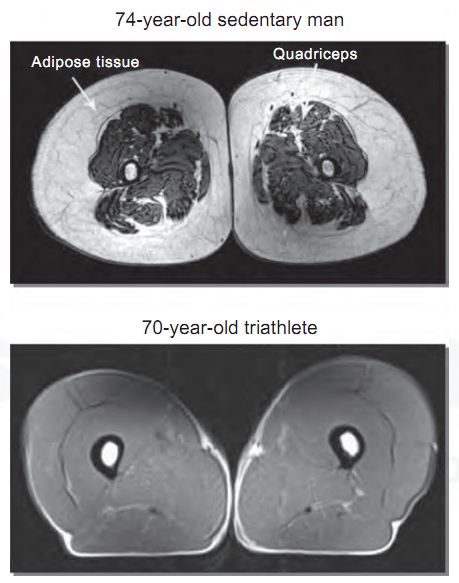
Here's the part most people underrate. Muscle mass declines roughly 1% per year starting in your 30s. Knee-extension strength declines about 2% per year in older adults, twice the rate of mass loss. Strength fades faster than the muscle itself, which is why falls become catastrophic in the seventh and eighth decades. The chair gets harder to stand up from years before the leg gets visibly thinner.
Training your legs isn't vanity. It's the single biggest lever you have on how the next thirty years feel.
The bottom line
Your legs are your largest muscle group, and training them is one of the most powerful things you can do for your metabolic and cardiovascular health. Squats, deadlifts, lunges, leg presses. These aren't aesthetic exercises. They're metabolic medicine. They protect your heart through the calf-muscle pump. They predict your longevity through quadriceps strength. They prevent falls and preserve independence.
So stop skipping leg day. Your heart, your blood sugar, your circulation, and your lifespan all depend on it.
Further reading: Cardiovascular health without cardio, Sarcopenia is reversible at any age, Strong at 80.