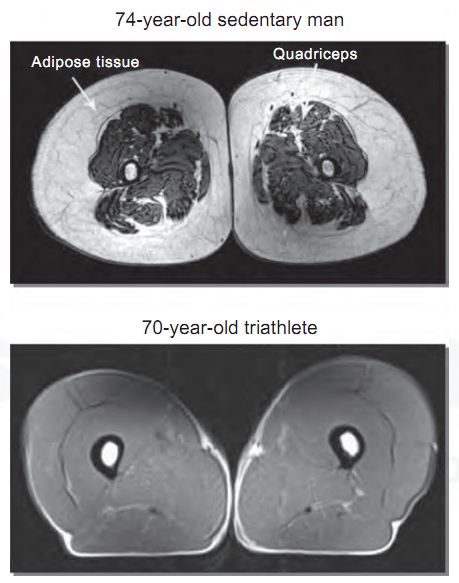
It does not matter if you have never trained, or trained for thirty years
Nonagenarians tripled their strength in eight weeks. Lifelong lifters added muscle in their seventies. The body does not stop responding to honest stimulus — and the studies that prove it have been in the New England Journal of Medicine for thirty-five years.

There is a story most adults tell themselves quietly: it is too late for me. I am too old. I never did this. I missed the window. Or, in the opposite direction: I have been training for decades, my body is what it is, there is no more upside.
Both stories are wrong. They are wrong in the same way, for the same reason, and the evidence has been in the literature — in JAMA, in the New England Journal of Medicine, in two dozen meta-analyses since — for more than thirty-five years. This is not new science. It is old science that almost no one acts on.
The body that has never trained, and the body that has trained for thirty years, respond to honest stimulus by the same rule: load it correctly, recover, repeat.
The 1990 study that should have ended the debate
In High-intensity strength training in nonagenarians: Effects on skeletal muscle (Fiatarone, Marks, Ryan, Meredith, Lipsitz & Evans, JAMA, 1990), researchers at Tufts took ten frail nursing-home residents — average age 90, three of them using walkers, two using canes, all of them with multiple chronic conditions — and put them on a basic high-intensity leg-strength program. Eight weeks, three sessions a week, three sets to near-failure.
The results were almost embarrassing to publish, because they sounded made up. Strength on the leg-extension machine went up, on average, by 174%. Mid-thigh muscle cross-sectional area increased by 9%. Two of the participants no longer needed their canes. One was able to rise from a chair without using the armrests for the first time in years. These were not athletes. They were not 'aging well'. They were the population every retirement brochure quietly assumes is past the point of intervention.
The follow-up that confirmed it at scale
Four years later, the same lab published Exercise training and nutritional supplementation for physical frailty in very elderly people (Fiatarone et al., New England Journal of Medicine, 1994), a randomised controlled trial with 100 frail nursing-home residents, mean age 87. Same protocol class: progressive resistance training to near-failure, two to three times a week, for ten weeks.
Muscle strength increased by 113%. Stair-climbing power increased by 28%. Gait speed increased by 12%. Spontaneous physical activity — the amount of moving around participants did when researchers were not watching — increased by an average of an hour a day. The control group, which received only nutritional supplements without training, showed essentially none of these effects. The variable that mattered was the load, not the calories.
If the body of a 90-year-old responds to honest training, the idea that a 40-year-old, or a 60-year-old, has 'missed the window' is not a physiological claim. It is a story.
And if you have trained for thirty years already?
The mirror-image worry — 'I have been lifting for decades, surely I am at my ceiling' — is also wrong, and the evidence is just as old. In Resistance exercise for muscular strength in older adults: a meta-analysis (Peterson, Rhea, Sen & Gordon, Ageing Research Reviews, 2010), the authors pooled 47 studies and found that lifelong lifters in their 60s and 70s continued to gain measurable strength and muscle mass when the stimulus was honest — load near failure, recovery respected, progression tracked. The rate of gain slows compared to a teenager. It does not flatten.
There is no biological cliff at 50, or 65, or 80. There is a slope. Slopes are negotiable. They are negotiated, in every published trial, by exactly the same lever: load the muscle hard enough that it has a reason to adapt, then let it adapt.
Why this matters beyond strength
The Fiatarone results are not interesting because the participants got 'stronger' in some abstract sense. They are interesting because the same intervention that adds strength to a 90-year-old also:
- Reverses early sarcopenia — the age-related muscle loss that, untreated, is the single best predictor of losing independence in old age.
- Improves glucose control, often as much as a first-line diabetes medication.
- Increases bone mineral density, lowering fracture risk in exactly the population where a fractured hip is a life-shortening event.
- Restores postural control and gait stability, dropping fall rates — and falls are the leading cause of accidental death over 65.
- Reduces depressive symptoms at effect sizes comparable to first-line antidepressant therapy, in multiple meta-analyses since.
This is what 'epitome of body and science knowledge' actually means in practical terms. It is not a slogan. It is the observation that one intervention — honest, brief, hard resistance training — produces the largest, most cross-cutting benefits of anything humans have ever tested on a human body, at any age, with no exclusions.
The framework, restated for both audiences
If you have never trained: you are not behind. You are the participant Fiatarone enrolled at 90 and finished at 91 with three times the leg strength. Your first session matters more than any session you will do in year five. Start light, fail honestly, recover. The first eight weeks will be the largest percentage change your body ever produces.
If you have trained for thirty years: you are also not behind. You are not at your ceiling. You are on a slope that you can negotiate, exactly the way you did at 25. The protocol does not change. The expected rate changes. The direction does not.
There is no age at which the body stops listening. There is only an age at which most people stop asking it the right question.
The proof
- Fiatarone MA, Marks EC, Ryan ND, Meredith CN, Lipsitz LA, Evans WJ. High-intensity strength training in nonagenarians: effects on skeletal muscle. JAMA. 1990;263(22):3029–3034. doi:10.1001/jama.1990.03440220053029
- Fiatarone MA, O'Neill EF, Ryan ND, et al. Exercise training and nutritional supplementation for physical frailty in very elderly people. New England Journal of Medicine. 1994;330(25):1769–1775. doi:10.1056/NEJM199406233302501
- Peterson MD, Rhea MR, Sen A, Gordon PM. Resistance exercise for muscular strength in older adults: a meta-analysis. Ageing Research Reviews. 2010;9(3):226–237. doi:10.1016/j.arr.2010.03.004
Read next: The best workout is the one you will still be doing in thirty years, Sarcopenia is reversible at any age, Strong at 80.