Is it strength training? Pilates, yoga, calisthenics, rowing, swimming — what counts and what doesn't
Apple Watch logs Pilates as 'Functional Strength Training.' Your yoga teacher swears it builds strength. Your rowing coach says it's a full-body workout. Here's the honest line — and what actually causes a muscle to grow stronger.

Type "is pilates strength training" into Google and you get 3,600 searches a month. "Is yoga strength training" — another 1,000. Calisthenics, rowing, swimming, even hiking — millions of people every month are trying to figure out whether the thing they already do counts.
The honest answer is one sentence: a movement is strength training if it loads a muscle hard enough, slowly enough, and long enough that the muscle's fast-twitch motor units are recruited and driven to momentary failure. Anything that doesn't meet that bar is something else — and something else is fine, it just won't make you stronger.
Strength is a response to a specific stimulus. Without that stimulus, repeated movement produces fatigue, sweat, and skill — but not strength.
What actually triggers strength adaptation
Henneman's size principle, established in the 1960s and confirmed every decade since, describes how the nervous system recruits motor units: smallest, slow-twitch fibres first, then larger fast-twitch fibres as load increases. The high-threshold fast-twitch fibres — the ones responsible for most of the strength and size adaptation — are only recruited when the lower-threshold fibres can no longer carry the load. That moment is called muscular failure. Everything that happens before failure is warming up the fibres that don't grow much.
This is why the variable that decides whether an activity "counts" is not how tired you feel, how sweaty you get, or how much you ache the next day. It is whether the loaded muscles reach a state where they physically cannot produce another full repetition. That state is rare in life. It is also the only thing the body reliably responds to with more strength.
The verdict, activity by activity
So what does count, without ambiguity
- Compound resistance work (squat, deadlift, press, row, pulldown, leg press) loaded heavy enough that you reach true muscular failure within 60–120 seconds of continuous tension.
- Machine-based HIT — one set per exercise, slow cadence, taken to failure. The protocol Doug McGuff describes in Body by Science.
- Hard calisthenics variations that meet the same failure criterion in the same time window.
- Isometric maximal-effort holds (overcoming-isometric protocols, when programmed to true failure).
If you finish your set knowing you could have done two more reps, you did endurance work. If the bar wouldn't move no matter what you did, that was strength training.
Why this matters past 40
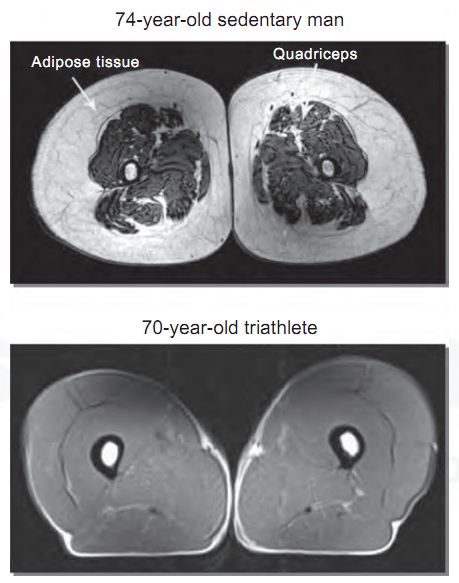
Sarcopenia — age-related muscle loss — begins around 30 and accelerates after 50. The only intervention shown to reverse it is genuine progressive strength training. Pilates won't do it. Yoga won't do it. Walking won't do it. They are all wonderful adjuncts; none of them substitute for a stimulus the body has spent 500,000 years evolving to respond to.
So do the Pilates. Do the yoga. Swim three mornings a week if it makes you happy. Just don't confuse them with the one thing that keeps you on your feet at 80 — a small dose of real, progressive, taken-to-failure load. Twelve minutes a week is enough. Less than that does almost everything more cardio can't.
The proof
- Henneman E, Somjen G, Carpenter DO. Functional significance of cell size in spinal motoneurons. Journal of Neurophysiology. 1965;28:560–580.
- Schoenfeld BJ, Grgic J, Van Every DW, Plotkin DL. Loading recommendations for muscle strength, hypertrophy, and local endurance: a re-examination of the repetition continuum. Sports. 2021;9(2):32. doi:10.3390/sports9020032
- Fiatarone MA, Marks EC, Ryan ND, et al. High-intensity strength training in nonagenarians: effects on skeletal muscle. JAMA. 1990;263(22):3029–3034.
Read next: How much strength training per week?, What is functional strength training, really?, Why 12 minutes is enough.